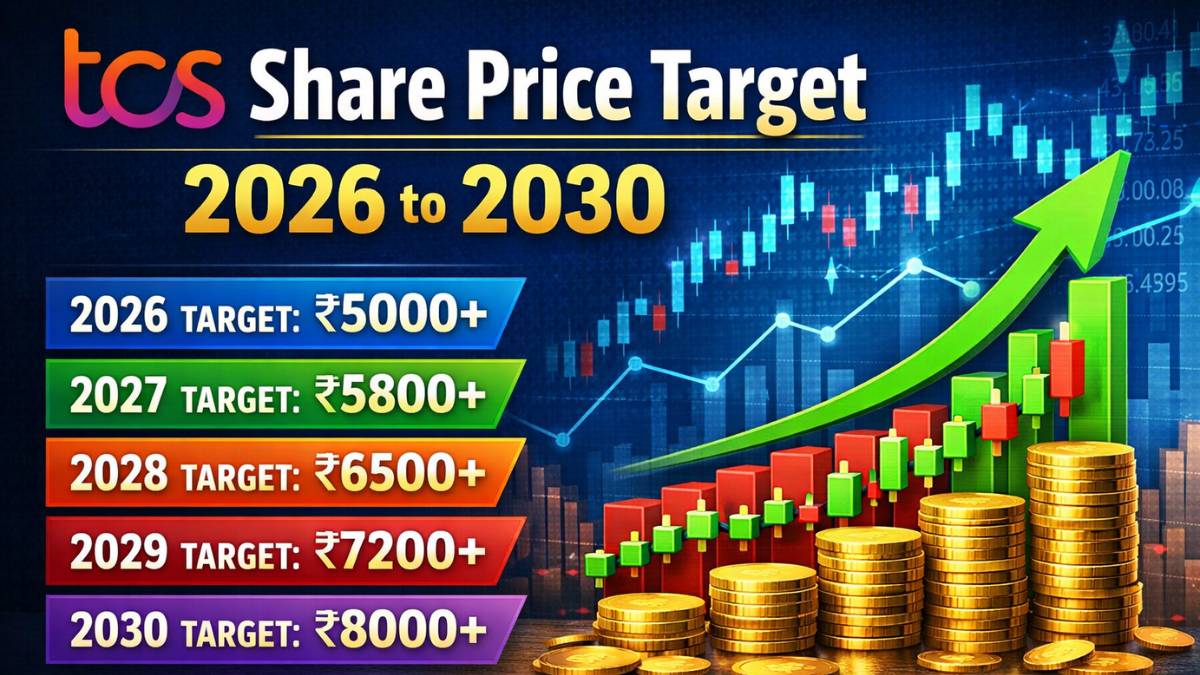
TCS Share Price Target 2026 to 2030
Tata Consultancy Services, widely known as TCS, is India’s largest IT services exporter. It plays a key role in the country’s digital economy and serves global enterprises across industries.
TCS is part of the respected Tata Group. Founded in 1968, the company has grown from a small IT division into a global technology leader.
Today, TCS operates in more than 50 countries and delivers technology solutions to some of the world’s largest corporations.
TCS Fundamentals: Financial Strength Overview
Before discussing the TCS share price target 2030, we must understand its financial foundation.
Based on recent publicly available data:
| Company Name | Tata Consultancy Services |
|---|---|
| Market Cap | ₹ 9,24,910 Cr. |
| Book Value | ₹ 294 |
| ROE | 52.4 % |
| ROCE | 64.6 % |
| Industry P/E | 18.2 |
| EPS (TTM) | 134.20 |
| Dividend Yield | 2.33% |
| P/B Ratio | |
| 52 Week Low | INR 2,561.30 |
| 52 Week High | INR 3,710.00 |
| Official Website | Tata Consultancy Services |
Last 5 Years Growth Financial Data
| Year | Assets (₹ Cr) | Revenue (₹ Cr) | Profit (₹ Cr) |
|---|---|---|---|
| 2021 | 129,992 | 164,177 | 32,562 |
| 2022 | 140,924 | 191,754 | 38,449 |
| 2023 | 142,859 | 225,458 | 42,303 |
| 2024 | 145,472 | 240,893 | 46,099 |
| 2025 | 158,649 | 255,324 | 48,797 |
TCS Share Price Forecast 2026 to 2030
| Years | Target Price Range (₹) |
|---|---|
| 2026 | ₹4,300 – ₹4,900 |
| 2027 | ₹4,900 – ₹5,500 |
| 2028 | ₹5,500– ₹6,200 |
| 2029 | ₹6,200 – ₹7,100 |
| 2030 | ₹7,100 – ₹8,200 |
Also Read
Vodafone Idea Share Price Target 2026, 2027, 2028, 2029, 2030
What These Numbers Indicate
A high ROE shows efficient capital utilisation.
- Almost zero debt means financial safety.
- Stable profit margins reflect operational strength.
- Consistent dividend payments make it attractive for income-focused investors.
Overall, TCS fundamentals remain solid for long-term portfolio allocation.
TCS Share Price Target 2026 to 2030
Long-term projections depend on revenue growth, global IT demand, profit margins, and valuation multiples.
These estimates are not guarantees. They are logical projections based on moderate earnings growth.
TCS Share Price Target 2026
By 2026, global IT spending is expected to remain stable. Enterprises will continue investing in cloud migration and digital transformation.
TCS may benefit from:
- Large outsourcing deals
- BFSI sector growth
- Cost optimisation services
TCS Estimated Price Range (2026)
- Lower Range: ₹4,300
- Upper Range: ₹4,900
- Average Target: ₹4,600
This assumes annual revenue growth of 8–10% with steady operating margins.
The TCS share price target 2026 looks achievable if global demand remains steady.
TCS Share Price Target 2027
By 2027, automation and AI adoption may accelerate across industries.
TCS is investing heavily in AI platforms and analytics services.
Growth drivers may include:
- Digital transformation in emerging markets
- Increased cybersecurity spending
- Expansion of enterprise cloud solutions
Estimated Price Range (2027)
- Lower Range: ₹4,800
- Upper Range: ₹5,500
- Average Target: ₹5,150
Currency movements and global economic stability will influence performance.
TCS Share Price Target 2028
India’s domestic digital push may create additional opportunities by 2028.
Government tech projects and smart infrastructure initiatives could support growth.
Estimated Price Range (2028)
- Lower Range: ₹5,400
- Upper Range: ₹6,200
- Average Target: ₹5,800
Sustained EPS growth will be the key factor behind this valuation.
The TCS stock forecast 2028 reflects steady, not explosive growth.
TCS Share Price Target 2029
By 2029, AI and automation may become standard business tools globally.
TCS has strong research capabilities and domain expertise.
It may improve productivity and protect margins.
Estimated Price Range (2029)
- Lower Range: ₹6,200
- Upper Range: ₹7,100
- Average Target: ₹6,650
Long-term outsourcing demand will remain a major driver.
TCS Share Price Target 2030
Looking at the TCS share price target 2030, long-term technology adoption remains the biggest theme.
Key growth pillars:
- Artificial intelligence services
- Cloud modernisation
- Global IT outsourcing
- Strong client retention
- Brand credibility
Estimated Price Range (2030)
- Lower Range: ₹7,000
- Upper Range: ₹8,200
- Average Target: ₹7,600
These projections assume moderate earnings growth and stable valuation multiples.
Shareholding Pattern and Investor Confidence
The shareholding pattern reflects stability.
- Promoter Holding (Tata Group): Around 72%
- Foreign Institutional Investors: 12–14%
- Domestic Institutional Investors: 8–10%
- Retail Investors: 6–8%
High promoter holding indicates long-term commitment.
Institutional presence shows global trust in the company.
Lower retail participation reduces short-term volatility.
Core Business Segments
TCS provides a wide range of services:
- IT consulting
- Cloud computing solutions
- Artificial intelligence and automation
- Cybersecurity services
- Enterprise application services
- Digital transformation consulting
Most of its revenue comes from long-term contracts. This ensures stable cash flow and predictable earnings.
Global Presence and Client Base
TCS earns a large share of revenue from:
- North America
- Europe
- Asia-Pacific
- Middle East
Its clients operate in sectors like banking, healthcare, retail, telecom, manufacturing, and insurance.
This diversified exposure reduces dependency on one single market.
Growth Opportunities for TCS
1. Rising Global IT Spending
Businesses worldwide are shifting to digital platforms. This trend supports long-term revenue visibility.
2. AI and Automation
Artificial intelligence, machine learning, and robotic process automation will continue driving demand.
3. Cloud Migration
Enterprises are moving from legacy systems to cloud infrastructure.
TCS has strong partnerships with global cloud providers.
4. Strong Brand Value
Being part of the Tata brand enhances credibility.
Client retention remains one of the company’s biggest strengths.
Risks and Challenges
Even strong companies face risks.
- Global recession or slowdown
- Currency fluctuations
- Pricing pressure from competitors
- Rapid technological disruption
- Increased competition from global IT firms
Investors should monitor quarterly earnings and deal wins.
Is TCS a Good Long-Term Investment?
TCS is a mature large-cap IT stock.
It offers:
- Stable earnings
- Strong return ratios
- Regular dividend income
- Financial safety
However, hyper-growth expectations may not be realistic.
The TCS long-term investment outlook appears steady rather than aggressive.
It may suit conservative investors seeking stability over high-risk growth.
Conclusion: TCS Share Price Target 2026 to 2030
The TCS share price target 2026, 2027, 2028, 2029, 2030 depends largely on global IT spending trends and company execution.
With strong fundamentals, high ROE, and almost zero debt, TCS remains one of India’s most dependable IT companies.
Long-term investors should focus on earnings growth, margin stability, and valuation discipline instead of short-term price fluctuations.
Technology adoption will continue globally. If TCS maintains its leadership position, steady appreciation remains possible over the next decade.
Frequently Asked Questions (FAQs)
1. What is the TCS share price target for 2026?
The estimated range for 2026 is ₹4,300 to ₹4,900, assuming moderate revenue growth and stable margins.
2. What could be the TCS share price target 2030?
Based on long-term projections, it may trade between ₹7,000 and ₹8,200, depending on earnings growth and valuation levels.
3. Is TCS a good stock for long-term investment?
TCS is considered a stable large-cap IT stock suitable for conservative investors seeking steady returns.
4. Does TCS give dividends regularly?
Yes, TCS has a strong history of paying consistent dividends.
5. What are the main risks for TCS stock?
Global economic slowdown, currency risk, pricing pressure, and rising competition are key risks.
Read More
- Infosys Share Price Target 2026–2030
- HCL Technologies Share Price Analysis
- IT Sector Growth in India
- Best Long-Term Stocks for 2030
- How to Analyse IT Stocks for Investment
